Before we talk about numbers, the most important thing to say is this: price is not the first thing to check when you are planning laser vision correction. It is not the last thing either. It is simply not the first.
I say this because in my clinic in Haifa I meet a great many people who arrive with a careful price comparison across four centres, and without an answer to the more important question — whether their cornea is even suitable for the procedure they are pricing. On this page I am trying to do two things: explain what actually makes up the price, and give you the list of questions I would ask if I were the one receiving a quote.
Why there is no price list here
An earlier version of this page carried a detailed price table naming specific centres with exact figures. I took it down, and I think you should know why.
The first reason is that price lists go stale. The negotiated rates between the funds and the centres are updated periodically, and a table that was accurate when it was written becomes, within months, a table that misleads people without anyone noticing. The second reason is that the number in the table is almost never the number you will pay: it does not include the pre-operative workup, does not always include the follow-up visits, almost never includes the drops, and often does not include a retreatment. The third reason is simpler — I am a surgeon working in this field, and I do not think it is right for me to rank competing centres by price.
What I can do is explain exactly which factors move the price up and down, what each fund actually provides, and how to read a quote. The final number will come from the centre that examines you — and it is always worth asking for it in writing.
The same logic guides me on the parallel page about the cost of cataract surgery.
The thing that most affects the price happens before surgery
The pre-operative workup is not a formality and it is not a sales step. It determines which procedures are open to you at all — and since price follows from the type of procedure, it is what actually sets the price range that is relevant to you.
Here is what gets measured:
Corneal thickness. LASIK requires creating a flap in the cornea, and that consumes thickness. A cornea that is too thin takes LASIK off the table and leaves PRK, and sometimes leaves PRK only within a limited range of correction.
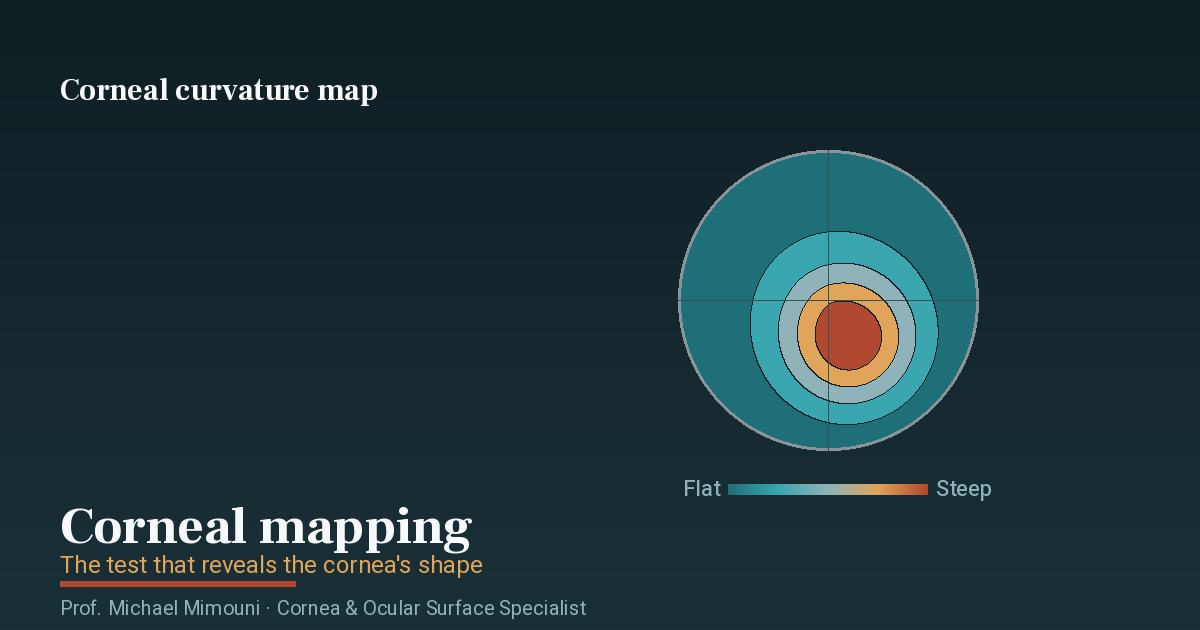
Corneal topography. This is the test that reveals irregularities in corneal shape, among them early signs of keratoconus. A cornea with a suspicious pattern is the most common reason I say no, and sometimes it moves the conversation somewhere else entirely — to monitoring or to cross-linking rather than to refractive surgery.
The size and stability of your refractive error. A very high correction may exceed what can safely be treated with a laser on the cornea, at which point the conversation shifts to intraocular solutions, which are a different world both in price and in the considerations involved. A prescription that is still changing from year to year is a good reason to wait.
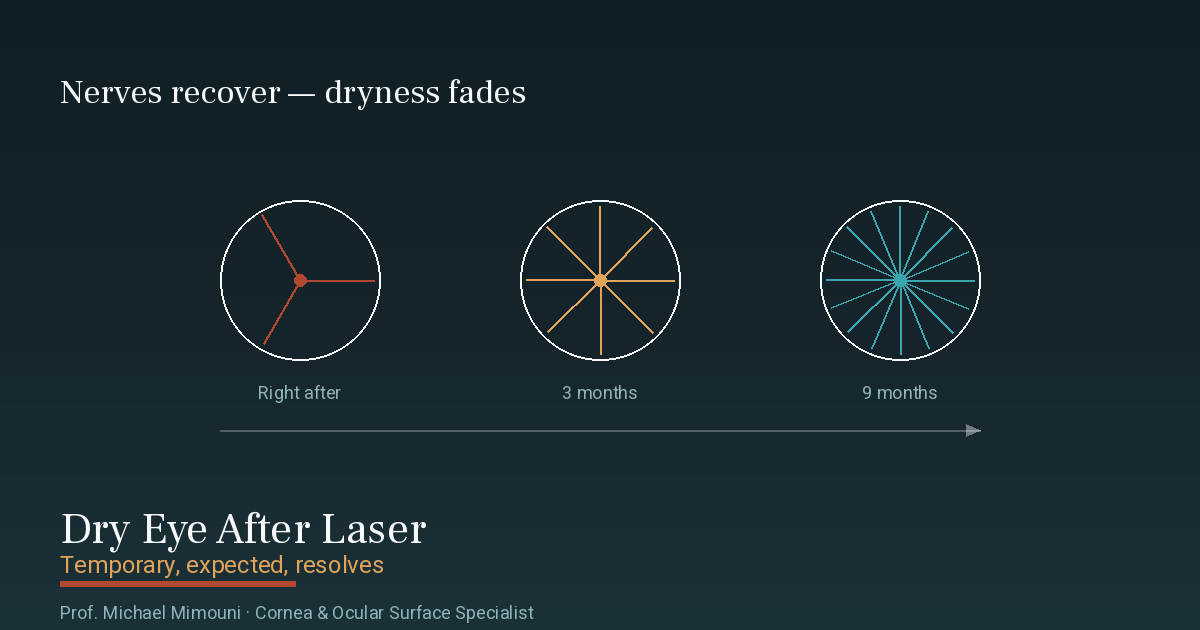
Dry eye. Dryness that exists before surgery tends to worsen afterwards, at least temporarily. A patient with significant dryness will usually need treatment beforehand before we even discuss a date — and that is a real cost worth accounting for in advance. I have written about this at length on the page about dry eye after laser surgery.
Pupil size and night vision. A large pupil affects optical side effects at night, and therefore affects treatment planning.
Some centres charge for the pre-operative workup and some credit it against the price if you go ahead with surgery. Ask in advance. And more importantly — if the workup ends with you not being a good candidate, that is the most economical outcome you could have had, even if it does not feel that way at the time.
PRK, LASIK and SMILE — the difference, and what it is really worth
The three common techniques correct exactly the same thing — the shape of the cornea — and differ in how they reach the layer being reshaped.
In PRK, the outer epithelial layer is removed, the laser is applied, and a therapeutic contact lens is placed until the epithelium grows back. There is no flap, which is why this is the option that stays open when the cornea is relatively thin or the topography is not perfect. The price is usually lower, but recovery is longer and uncomfortable in the first few days. I have built PRK recovery calculators based on data from more than 180,000 procedures, and they give a personalised estimate for the questions of when vision returns and when you can drive.
In LASIK, a thin flap is created, the laser is applied beneath it, and the flap is returned to position. Recovery is considerably faster and nearly painless, which is why this is the preferred option for those suited to it. The price is higher, partly because of the additional step and the additional equipment.
In SMILE, a disc of tissue is extracted through a small incision, without a full flap. The technique is offered at fewer centres and is usually priced at the upper end of the range.
The point I want you to take from this: the price difference between the techniques is real, but it should not be the deciding factor. A cornea unsuitable for LASIK does not become suitable through a willingness to pay more, and conversely, a patient well suited to PRK does not get a better result merely by paying for a more expensive technique. Choosing the technique is a medical decision made against the data from your own eye.
What is worth paying extra for in technology
This is the area where it is easiest to get carried away, so it is worth separating what genuinely matters from what is marketed as though it matters.
Femtosecond laser flap creation rather than a mechanical microkeratome produces a more uniform and more precise flap, and that is an addition with a basis. In most centres in Israel it is already the default rather than a paid upgrade.
Wavefront-guided or topography-guided treatment is mainly suited to people with higher-than-usual optical aberrations, corneal irregularity, or complaints about night vision. For a patient with an ordinary eye and a straightforward prescription, the additional benefit is smaller. It is a legitimate question to ask: why do I in particular need this.
Mitomycin C in PRK reduces post-operative corneal haze, mainly in higher corrections. This is not a luxury upgrade, it is a clinical decision.
Device version or laser generation. Centres sometimes emphasise the model name. The model matters less than the marketing implies; what matters more is who plans the treatment, on the basis of what data, and what happens when something does not go according to plan.
In the work I have published over the years on the outcomes of tens of thousands of procedures, the trend that recurs is that the risk of complications has fallen over time — as a result of a combination of technique, technology and knowledge, and not because of any single component that can be bought as a paid extra.
What the health funds actually provide
This is where there is the most confusion, so I am trying to be precise. Three structural facts are worth absorbing before the details:
First, laser surgery to correct refractive error is not in the national health basket. It is not a statutory right. It is available only through supplementary insurance — the shaban — or through full self-payment.
Second, this is almost always a reduced co-payment rather than a cash reimbursement. The fund does not refund you after you have had surgery wherever you liked. It has agreed a rate with centres it holds a contract with, and you pay the centre the co-payment. The practical meaning: your fund determines not only how much you pay but also where you can go.
Third, the entitlement belongs to the plan, not to the fund. This is the most common mistake I hear. “I’m with Clalit” says nothing on this question; “I’m with Clalit Mushlam Platinum” does.
As of July 2026, this is how it is published on the funds’ own websites:
Clalit
The entitlement exists under Mushlam Platinum only, from age 18, and is worded as surgery to correct myopia at a low co-payment in contracted institutes. Clalit itself notes that the service is not in the basket and that it is provided within the supplementary insurance. The rights page was updated in June 2025, and the most recent published tariff update is dated October 2024. If you are on basic Mushlam rather than Platinum, it is worth confirming your status before you count on the benefit.
Maccabi
The entitlement exists under Maccabi Sheli only — not under Maccabi Silver and not under Maccabi Gold. The published terms: from age 18, after six months from the date of joining the plan, and one realisation per membership period. Payment is made directly to the contracted institute, in the amount of the co-payment only. The last update date shown on the page is July 2024. I have written at length about navigating Maccabi on the page about a recommended Maccabi eye doctor.
Meuhedet
The entitlement exists under both Meuhedet Adif and Meuhedet Si, with Si defined as improved terms relative to Adif. Here too: from age 18, a qualifying period of six months from the date of joining, a co-payment that varies by type of procedure and by centre, and only at an institute or hospital contracted with the fund. A member who has moved from Adif to Si can usually exercise the benefit during the qualifying period under Adif’s terms.
Leumit
The entitlement is published under Leumit Gold, not under Leumit Silver, with a six-month waiting period and realisation at contracted centres.
What to ask your fund before you set a date
- Whether my plan — not my fund — includes the entitlement today.
- Whether the qualifying period has passed, and from which date it is counted.
- Whether the entitlement applies to astigmatism and hyperopia as well, or only to myopia.
- Whether the co-payment covers two eyes or one.
- Whether the pre-operative workup, the follow-up visits and a retreatment are included in the arrangement or priced separately.
- Whether there is a limit on realisation — once in a lifetime, once per membership period, or no limit.
Terms change from time to time, and contracted tariffs are updated. Do not rely on what you have read — not even here. Ask the fund for written confirmation of eligibility.
What must appear in the quote
A good quote is one you can compare. These are the line items I ask every patient to make sure appear explicitly:
The pre-operative workup — charged separately or included, and what happens if it turns out you are not suitable.
How many eyes — it sounds trivial, and it is a leading source of illusory gaps between quotes.
Post-operative follow-up — how many visits, over what period, and with whom.
Medications and drops — these cost real money, especially in PRK, and are usually not included.
The therapeutic contact lens in PRK.
Retreatment — whether it is included, for how long, and under what conditions. See the next section.
Treatment of a complication — if a problem develops that requires monitoring or treatment, who treats it and who pays.
Who actually performs the surgery — an entirely legitimate question, and at some centres the answer is not self-evident.
Retreatment — the line item that is easiest to miss
In work following the outcomes of some 70,000 procedures over roughly two decades, the rate of needing an enhancement procedure fell substantially: from around five percent fifteen years ago to a range of one to two percent today, depending on the eye and the starting prescription. That is a low rate — but it is not zero, and if it happens to you, the difference between a quote that includes an enhancement and one that does not is the only difference that will interest you.
Pay attention to the wording. “Warranty” and “enhancement included” are not the same thing. Some arrangements limit the enhancement to a window of time, some condition it on a minimum deviation from the planned result, and some require the prescription to be stable. All of these are reasonable in themselves — the only problem is discovering them afterwards.
Is it worth it
The usual economic argument is that glasses and contact lenses cost money over the years, so a one-off procedure pays for itself in the long run. That argument is broadly right, but it rests on very personal assumptions — how much you actually spend, what age you are, and how many years you are projecting forward.
What I tend to add to the conversation are two things that get discussed less.
The first is that contact lenses are neither free nor risk-free. Models comparing cumulative risk have shown that the risk of a complication from prolonged contact lens wear is not negligible relative to the risk of laser surgery. This is not an argument for having surgery — it is an argument against the assumption that doing nothing is a cost-free, risk-free option.
The second is age. Laser surgery corrects the prescription you have today. It does not prevent the near-vision changes that arrive in the mid-forties, and it does not prevent cataract later in life. If you are in your fifties or beyond and considering laser surgery, the more appropriate conversation is often about lens replacement instead — and I have set out the considerations there on the page about choosing a lens for cataract surgery. That is not necessarily a more expensive or a cheaper conversation, but it is a different one.
What I cannot promise you
I cannot promise that you will part with glasses entirely. In the great majority of suitable candidates the result is very good, and in some a mild dependence remains under certain conditions — night driving, prolonged reading. Nor can I promise that you will not experience dryness or glare in the first months; in most people this passes, in a minority it persists.
And what I certainly cannot promise is that a lower price indicates something bad, or that a higher price indicates something good. The correlation between the two is far weaker than it is comfortable to think.
How I approach this
When someone comes to me with a price question, I first try to move the conversation elsewhere: what is bothering you today, what do you expect to change, and what does the examination show. Only once there is an answer to those three does a number mean anything at all, because only then do we know which procedure we are talking about.
I also tell people plainly when they are not good candidates, even when they very much want to go ahead. Some of the people sitting across from me leave with a recommendation to continue with glasses or contact lenses, and some leave with a recommendation to monitor the cornea before surgery is discussed at all. It is not a popular answer, but it is far cheaper than surgery that should not have happened.
If you would like to go over your own data and understand what range is relevant for you — you can book an examination and assessment.
Frequently asked questions
How much does laser vision correction cost in Israel?
There is no single price. The private-market range is wide, and it follows from the type of procedure, the technology used, the centre, and whether you are exercising an entitlement through your health fund's supplementary insurance. I deliberately do not publish a price list here: price lists go stale within months, and the number that actually matters to you is the final one, including the pre-operative workup, the follow-up visits, the drops, and a retreatment if one is needed. You can only get that in a written quote from the centre that examines you.
Is laser vision correction covered by the national health basket?
No. Laser surgery to correct refractive error is not included in Israel's national health basket. It is available only through your health fund's supplementary insurance (shaban) — and not under every plan, only under specific ones — or through full self-payment.
Which health fund is best for laser eye surgery?
The right question is which plan, not which fund. As of July 2026, Clalit grants the entitlement under Mushlam Platinum only, Maccabi under Maccabi Sheli only, Leumit under Leumit Gold, and Meuhedet under both Adif and Si — with Si on improved terms. In every fund this takes the form of a reduced co-payment at contracted centres rather than a cash reimbursement, which means your fund determines where you can go, not only how much you pay.
How long must I be insured before I can use the benefit?
The funds I checked publish a qualifying period of about six months from the date you joined the plan, with eligibility from age 18. Maccabi also publishes that the benefit may be exercised once per membership period. Terms change from time to time, so confirm them with your own fund before you plan a date.
Is a retreatment included in the price?
Not always, and this is one of the expensive line items that is easiest to miss. Ask in writing whether an enhancement procedure is included, for how long, and under what conditions — for example, whether it is conditional on a minimum deviation from the planned result. The likelihood of needing a second procedure has fallen substantially over the years and now sits at roughly one to two percent, but when it does happen, the gap between a quote that includes it and one that does not is significant.
Which is better — PRK, LASIK or SMILE?
Whichever suits your cornea, not whichever costs more. The choice is determined mainly by corneal thickness, corneal topography, the size of your refractive error and the state of the ocular surface. There is a real price difference between the techniques, but it should not be the deciding factor — a cornea that is unsuitable for LASIK does not become suitable because the patient is willing to pay more.